
Thousand-Acre Naples Property Listed for $70 Million
Fate of Oceanfront Ranch Land Northwest of Santa Barbara Up for Grabs
By Callie Fausey | SANTA BARBARA INDEPENDENT
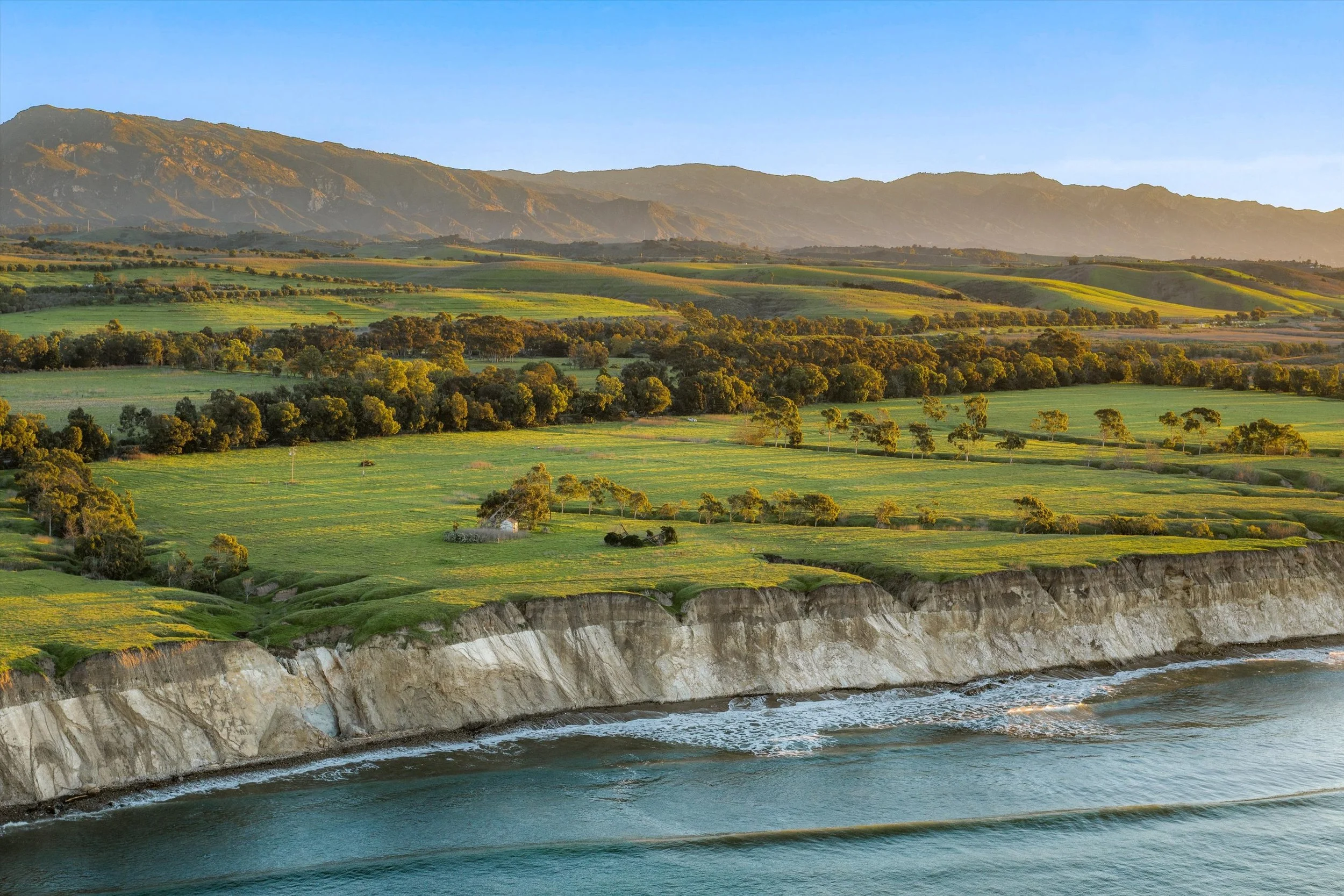
Naples, a scenic stretch of the Gaviota Coast, is back on the market for $70 million.
A historic and largely undeveloped stretch of the Gaviota Coast is back on the market.
The current owner of roughly 1,000 acres at Naples — also known as “Santa Barbara Ranch” — has listed the entire sprawling property for $70 million.
Sitting northwest of Santa Barbara, the oceanfront ranch, currently used for cattle grazing, spans rolling grasslands with sweeping coastal views. The property includes parcels stretching from the mountainside to the bluffs, access to the “Naples” surf break and the nearby reef, and an 18-acre lake with bass fishing, according to its listing by Berkshire Hathaway HomeServices.
But this scenic property comes with baggage — including a past of failed development proposals and persistent community efforts to preserve the land.
“It’s extremely controversial … quite a history,” said lister Kerry Mormann, a broker who specializes in coastal ranch sales.
“It’s not an easy job, but my goal is to try to find somebody who will respect and preserve this property,” he said.
Preserving Naples would involve far fewer regulatory hurdles than building on it.
Everyone wants a piece of the pie — but the pie’s location, land-use constraints, and legal history have made it difficult to develop.
Decades of development pressure have been met by opposition from local environmental organizations seeking to protect the Gaviota Coast’s rural and ecological character. The property’s complicated past has left a paper trail that could stretch end-to-end along its mile-long coastline.
David Liu, a wealthy investor based in Arcadia, has held the property for roughly a decade and is now looking to sell, according to Mormann. He described Liu as a “quiet guy” and said he could only speculate about why Liu is selling now or whether he ever seriously pursued development.
Nevertheless, Liu has about $80 million invested in the property. At the current asking price, he would be taking a loss, and is showing “real motivation to sell,” Mormann said.
The listing could present an “excellent opportunity for the right conservation buyer or organization,” he emphasized.
Mormann added that he contacted local conservation groups — including the Land Trust of Santa Barbara County — to gauge interest and let them know he is an “ally, not an enemy.”
“But they need to be aware that this could be broken up, and there could be some limited development,” he said.
When asked whether the Land Trust would be interested in buying the property, communications manager CJ Benavidez said: “We are aware that the property is for sale and are evaluating the situation.”
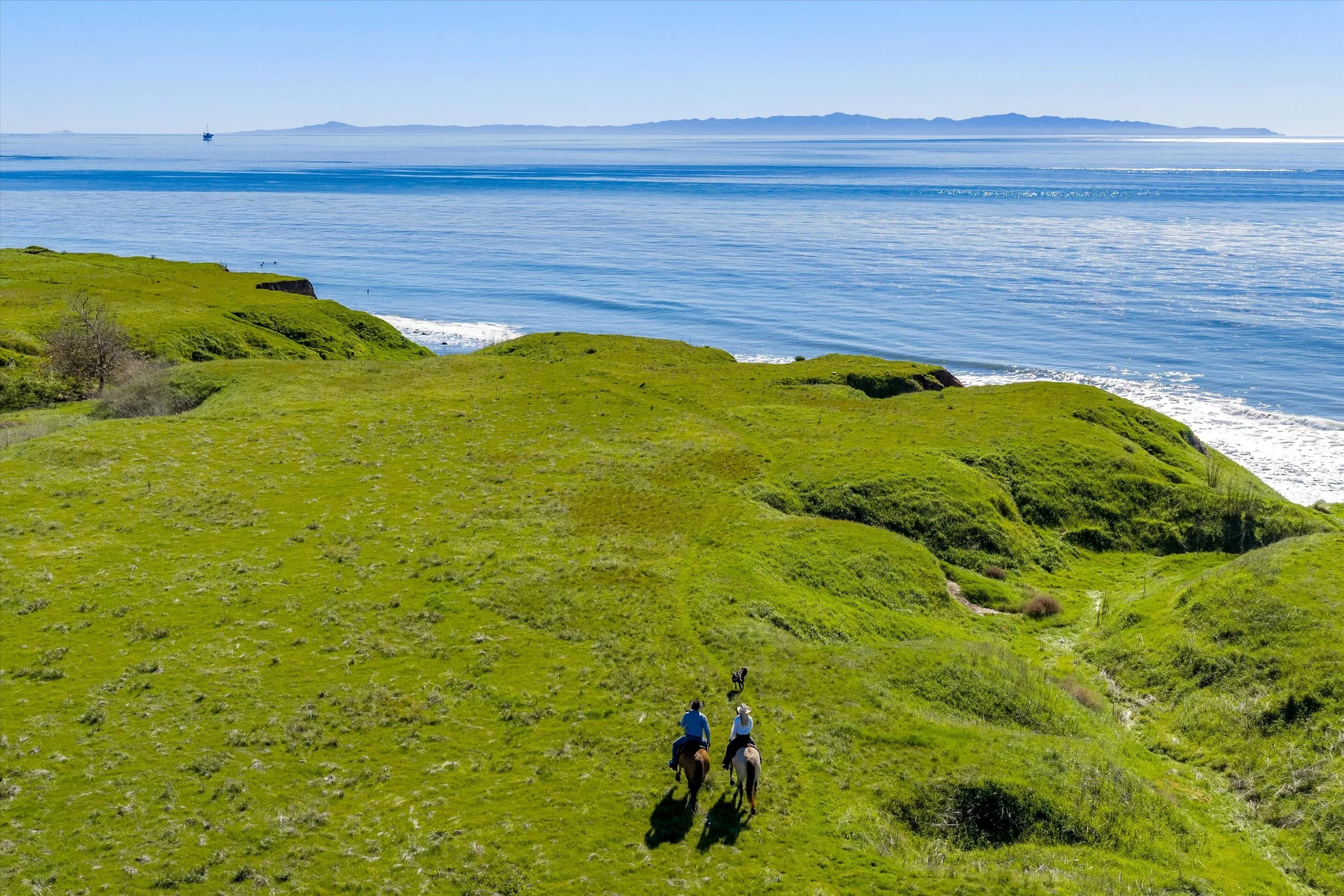
Naples’s uses include cattle ranching, horseback riding and surfing.
A Complex History
Many have tried to make a neighborhood out of Naples.
Naples’s listing on Mormann’s website begins with its “rare geological position” along the Santa Ynez Mountains. It briefly touches on the area’s history, beginning with Chumash stewardship — the coast is part of their ancestral territory, with the ancient village of Kuya’mu located in the southwest corner of the modern-day ranch.
“In fact, this is where Santa Barbara was discovered by Juan Cabrillo in 1542,” the listing states.
Using panoramic views of the undeveloped coastline — featuring horseback riders and surfers — Mormann frames Naples as the “city that was never built.”
An “ambitious” townsite plan created in 1888 laid out 500 potential lots along a grid of crisscrossing streets. But because of a lack of infrastructure and economic challenges, the city never became reality.
More than a century later, the idea resurfaced. In 2008, after a long and complicated administrative process, Naples was approved as a legal subdivision with 72 homesites. Yet the project again fell apart amid local opposition, financial pressures and land constraints. The project went belly-up and the property was foreclosed on by First Bank. Liu purchased it in 2015.
Everyone who has been part of the Naples novella tends to agree on one point: It’s a mess.
“The ground is littered with the broken picks of developers,” said Santa Barbara attorney Marc Chytilo, who represented environmental groups in previous litigation over the property.
“The title and land-use constraints on the Naples parcels and the surrounding lands are extremely complicated,” Chytilo said. “Any development interests would likely find those restrictions daunting.”
Environmental Opposition
Conservation groups argue the Gaviota Coast is one of the last remaining stretches of undeveloped coastline in Southern California and provides habitat for rare and endangered birds and bees.
For decades, the Gaviota Coast Conservancy has fought development at Naples, advocating instead for public acquisition of the land.
The group envisions the property being used by the Chumash for cultural expression, restoring grazing lands and prime soils through regenerative agriculture, providing public access, completing a mile-long segment of the California Coastal Trail, and altogether “preserving the viewshed and rural character of the Gaviota Coast.”
More recently, the conservancy — alongside the Environmental Defense Center and Surfrider Foundation — has been fighting a proposed seaside estate on an oceanfront parcel owned by Dr. Peter Ma of Diamond Bar.
Ma’s property is not included in the current sale, but his project has slowly been moving through county approvals and has faced appeals from environmental groups.
With the neighboring sales underway, the decisions surrounding Ma’s lot could become “precedent-setting,” according to Tara Rengifo, a senior attorney with the Environmental Defense Center (EDC) — whether the project ultimately reaches construction or not.
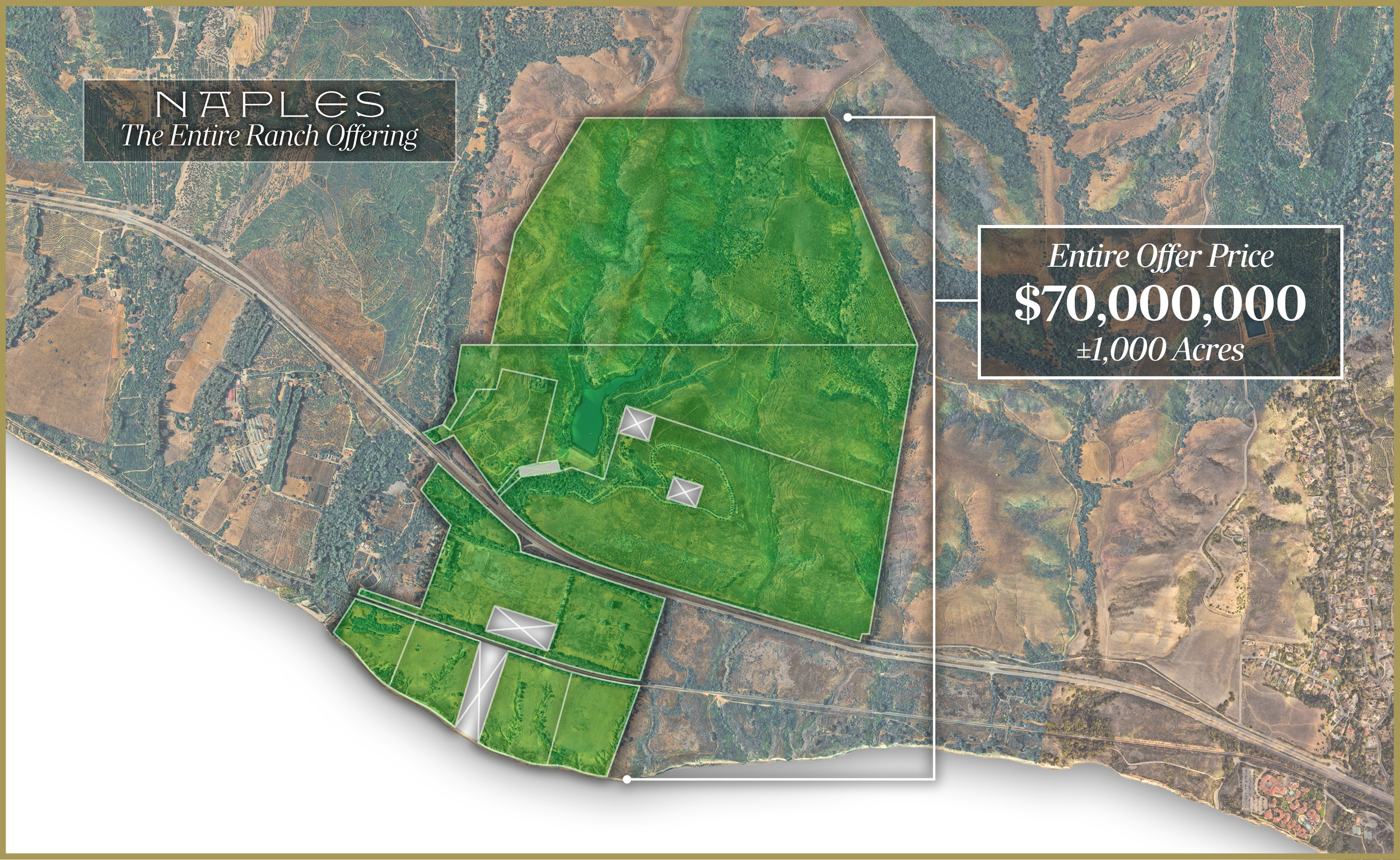
Entire Ranch Offer Price
The Sale
Naples’s future is now up for grabs. And many hands are reaching for it, according to Mormann.
He has divided the property into portions, including five 20-acre oceanfront lots listed at $15 million each that could appeal to developers.
Altogether, the North and South ranch offerings — located above and below the freeway — include more than 220 legal parcels with Certificates of Compliance.
Mormann said he is working with land-use planner Mark Lloyd, who has mapped out a potential scenario that could allow for development of 10 to 12 homes on the north side of the freeway and “perhaps five or six on the south side.”
“So, it’s a definite danger of development on the pristine Gaviota Coast,” he said.
At the same time, the property also presents an opportunity for consolidation and conservation easements that could permanently preserve most of the land, which would come with what Mormann called a “tremendous tax break” of up to 50 percent of the total cost.
Mormann has been fielding a lot of interest. He said he received about 20 calls about the property just last month, including from developers. But he reiterated that he hopes to attract a conservation-minded buyer.
“It would be a fantastic conservation project for a wealthy individual or an organization,” he said.
Advocates pushing for preservation are already paying attention.
Save Naples — a long-running public campaign to keep the land undeveloped — recently posted an announcement on Instagram outlining its goal to raise money to “secure all the properties.”
Phil McKenna, former president of the Gaviota Coast Conservancy who now sits on its board, said the group is not currently holding detailed discussions about acquiring the land. But he emphasized that its priorities remain the same.
“Acquisition was always an option, but what we needed to do was tamp down the development pressure,” he recounted.
“Our objective is to prevent development, facilitate sustainable agricultural use, and preserve its rural character,” he said.
No buyer has emerged yet.
For now, Naples’s future remains uncertain — whether it is development, conservation, or some combination of both.
View the offering memorandum here.